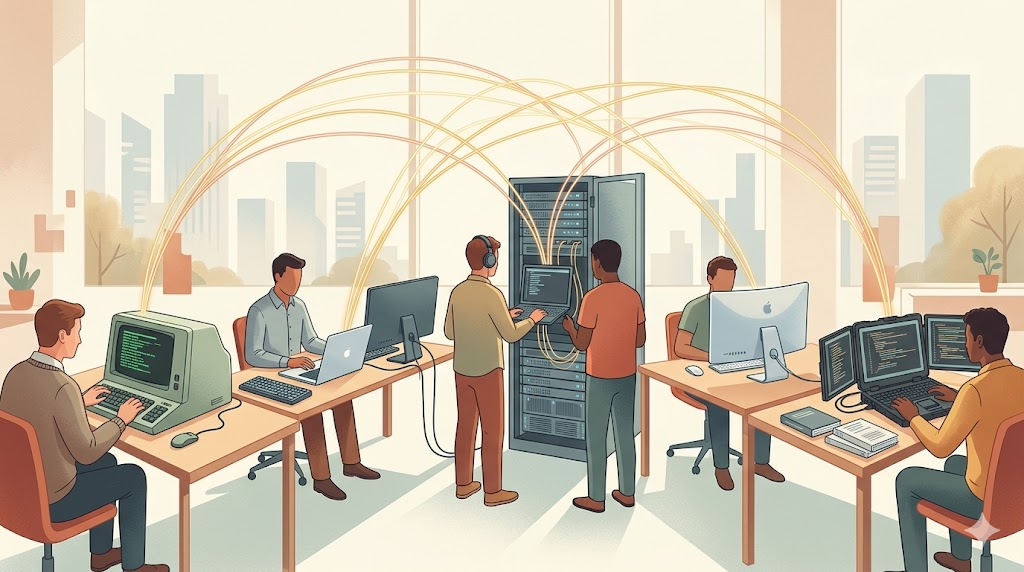
I have been leading infrastructure and security teams for over a decade, and one problem keeps coming back: knowledge does not spread on its own. Unlike a development team where everyone shares a stack, an infrastructure team is a collection of specialists, each owning a different product. When that specialist takes a vacation – or leaves – their knowledge often walks out with them. In this post I share what I have learned about why knowledge management is harder in infrastructure teams and the practices that have helped my teams keep knowledge in the room.
First, consider development teams. On a development team, engineers are largely interchangeable. They may work on different features, but they generally share the same stack: programming language, frameworks, build system. Onboarding still takes time because the stack can be complex, and business logic and codebase history do not transfer overnight. But once a developer understands the basics of the stack and the business logic, they can usually step into a teammate’s work without much friction.
Infrastructure teams are quite different. Instead of converging on a single stack, an infrastructure team manages a portfolio of products that often have nothing in common with each other. I am not claiming the work is harder than development – only that it is structurally more heterogeneous, and that heterogeneity is what makes knowledge so hard to share.
For instance, I once worked on a team that had to support both Linux and mainframe operating systems – two completely different worlds, demanding completely different engineer profiles. A Linux specialist and a mainframe operator could sit next to each other every day and never be able to cover for one another. I saw the same pattern leading an SAP infrastructure team. The stack spanned database administrators, NetWeaver experts, BASIS specialists, integration engineers (PI/PO), and identity management administrators – five specialties under one team, with almost no overlap between them. IDM in particular runs on a weird workflow engine – even a senior SAP BASIS engineer needs weeks of ramp-up before they can touch it.
So how to fight that? There is no silver bullet, but three practices have made a difference on my teams: encouraging documentation, rotating engineers through incident handling, and automating whatever can be automated. None of them eliminates the heterogeneity – they just keep knowledge flowing in the room.
First, pick one documentation tool and stick with it. A Git repository is often enough, but a SharePoint site, Confluence, or any other wiki works too. When you migrate content from old tools, take the opportunity to update what is outdated along the way. If a document is not worth updating right now, link to it from the new tool and mark it for future review. The engineer must document – it does not need to be perfect, but they need to take responsibility for writing.
Within documentation, separate playbooks (high-level tutorials) from runbooks (very detailed scripts) and technical reports. Within each type, categorize by technology or subject, so engineers can quickly find what they need. The playbook explains what to do. The runbook explains how to do it. Generally, a runbook can be reused in multiple playbooks. Finally, use technical reports to gather context or to write more complex settings that engineers need to understand the infrastructure.
Next, rotate engineers through incident handling. Incident handling is a natural opportunity for engineers to run simple tasks, test their access, and become familiar with the playbooks and runbooks of another specialty. A BASIS specialist, for instance, can learn to free disk space on a Linux server – or know which team to escalate to – without changing their day-to-day role. Incidents also force engineers to talk across specialties to resolve the problem – and because incidents are shorter and more contained than projects, that communication often happens and stays focused.
Finally, automate! Prefer tools like Ansible that describe each task declaratively, so the playbook itself becomes runnable documentation. Moreover, engineers can extend and reuse those automations, which spreads both the work and the knowledge across the team. Once a procedure lives in code, it stops walking out the door with the engineer who knew it.
Together, these practices make the team less fragile. Documentation captures what people know; rotation gives them chances to learn from each other; automation lets the system remember, so engineers do not have to.