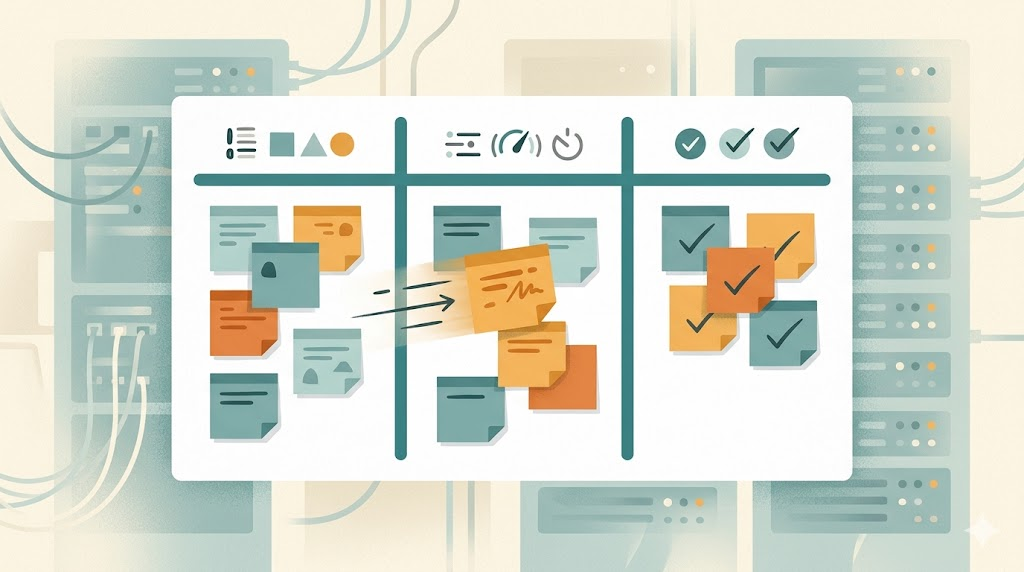
When I started leading an IT infrastructure team and introduced Kanban, I quickly realized that adopting agile methods would be far from trivial. Most Kanban guidance assumes a development team shipping features, but infrastructure work is heterogeneous, interrupt-driven, and partly executed by contractors – a mix that a standard board does not accommodate without adaptation. I faced several challenges and, over time, found a few adjustments that helped the team align around shared goals and keep work moving.
I ran into several problems that were unique to infrastructure teams. The first is heterogeneity. A development team usually shares a stack (language, framework, process, etc.), so its members can pair, review each other’s work, and rotate through tasks. In contrast, an infrastructure team is responsible for a diverse range of tasks and technologies. The team I led, for example, had one member responsible for an old mainframe and others responsible for a modern Linux server farm. The work is not inherently more complex, but it is far more varied, and that makes it harder to run a daily stand-up that feels relevant to everyone or to have team members support each other across skill sets.
Furthermore, there is a lack of literature focused on infrastructure teams. Most books and blog posts discuss Kanban in the context of development teams shipping features and bug fixes. The agile concepts themselves apply to any team, but the examples rarely do – and without examples that match the work, it is hard to know where to start adapting them.
Another challenge is the variety of task sizes within infrastructure work. It mixes incidents and service requests that take minutes, such as a password reset or a quick access grant, with project tasks that stretch over days or weeks. Moreover, my team supervised and advised on many tasks executed by contractors. Representing all of these on a single board was a challenge: the tasks varied widely in importance and duration, and without care the work in progress (WIP) would quickly get out of hand.
To handle this mix, I split the work into three groups, each managed differently on the board:
- Small requests: incidents and services requested by our clients that take less than one day to complete;
- Project tasks: work executed by the team itself, such as configuring a server or developing automation, plus any incident that runs longer than a day;
- Contractor tasks: work executed by contractors that the team supervises.
I started with the small requests. I struggled to solve this problem until I found this post from Joakim Sundén, author of Kanban in Action. The idea is to track them in a dedicated column: the team writes the request number and the owner, and crosses each one out once it is resolved. This way, the board represents the effort of the small requests without mixing them with the larger tasks. Later, we stopped writing those numbers by hand and instead displayed a live report from our ITSM that listed the requests in progress.
In the daily meeting, we did not discuss each request; we just glanced at the column to see whether the count was under control. When one of them demanded more attention, its owner brought it up, and we evaluated promoting it to a project task.
Next, I turned to the project tasks. These were the bulk of the team’s work and the category where a developer-style board fits best. A typical Kanban board for developers has three action columns – developing, testing, and deploying – which works well for shipping features. Project tasks in infrastructure follow a similar shape, but the columns need to be generalized to cover work that isn’t always developing or testing in the dev sense:
- Doing the work, such as configuring infrastructure, assessing its quality and compliance, developing automation, and writing contracts;
- Reviewing the work to assure its quality;
- Deploying the work to satisfy change and delivery management compliance.
Cards move through these three columns until done. Since different project tasks share the same board, it helped to define done for each project task in each column. For instance, applying a security patch was done in the doing column once it had been applied and documented on the development systems; done in the reviewing column once tested by other team members; and done in the deploying column once it reached the quality assurance and production systems.
The reviewing column was the hardest to operate, and in practice we skipped it for most tasks. The team combined very different skill sets – the mainframe person could not credibly review the Linux work, and vice versa – so peer review was rarely feasible, and reviewing simply did not apply to much of the workload. I will not solve that here because it is a broader problem of knowledge, training, and team management, but it is worth noting that an infrastructure board may often run with the reviewing column effectively bypassed.
One challenge that remained was epic tasks – long-running work that could stay parked in the same column for weeks. This is a common problem in agile methods, and the standard answer is to split the epic into smaller pieces. The hard part for infrastructure is finding splits that actually carry meaning. Applying a security patch across hundreds of production servers, for example, could take weeks; chopping it into “patch 50 servers” cards is artificial and adds little visibility. A more practical split is to group the servers by role or by deployment wave and give each group its own card – one for the application servers, another for the database servers, another for the next wave of edge nodes.
Next, I turned to the contractor tasks. Infrastructure teams generally manage several contracts in parallel, and a single team member can handle a couple of contractor engagements with different collaborators at once. These tasks behaved differently from the other two: the team did not execute the work; it supervised it. That meant the cards on our board represented attention rather than hands-on effort – tracking status, reviewing deliverables, raising quality issues, and signing off when work was complete. Mixing those cards into the project-tasks columns would have inflated the WIP without reflecting capacity: supervising five contractor work streams is not the same as doing five internal projects.
I tracked contractor work on a dedicated swim lane on the board, separate from the project-tasks columns. Each ongoing engagement got its own card, listing the contractor, the deliverable, and the next checkpoint. The card stayed visible for as long as the team had any responsibility for the work – through delivery, review, and acceptance – which made supervision visible to the rest of the team without competing with the project-tasks WIP limits.
None of these adjustments are radical departures from Kanban – they are local adaptations to make the method fit a team that does not look like a development team. The board became useful not because it solved every problem, but because it represented the work as it actually was: a mix of small requests, longer projects, and supervised work done by others.